I like the tradition, and what was the necessity of Polari.
I like to litter my conversation with a sprinkling of an odd word, or a phrase of Polari, It’s my small nod to my queer forebears, passing along a camp tradition.
I don’t like the idea that Queer acceptance into the “mainstream” (beige stream) means all vestiges of my woofter past should be, or need be, discarded in embarrassed shame.
It may only be a painted nail or two, or a twist of phrase, or preferencing ‘everyones’ name with ‘Miss’, or having ‘Lady’ names, but it’s a rich part of my history i will not abandon.
The following article originally appeared in the Sydney Star Observer.
Gary Nunn— October 14, 2014
YOU may not know it, but gay men used to speak their own language. It was called Polari, and it was fantabulosa (wonderful).
Okay, it was less of a language and more of a cant — a coded set of words used exclusively to avoid detection by unwanted outsiders — including the police, disapproving conservative society or the group on the table next to you that you’re bitching about.
Polari, used in the early 20th century in larger cities in a very priggish Britain, forms part of a long tradition of gay lexicon: the words used by gay men and, to a slightly lesser extent, lesbians. The language we use about ourselves and each other is still coded even today — often to spare the blushes of outsiders or to shroud in secrecy our peccadillos, put-downs and peculiar fetishes.
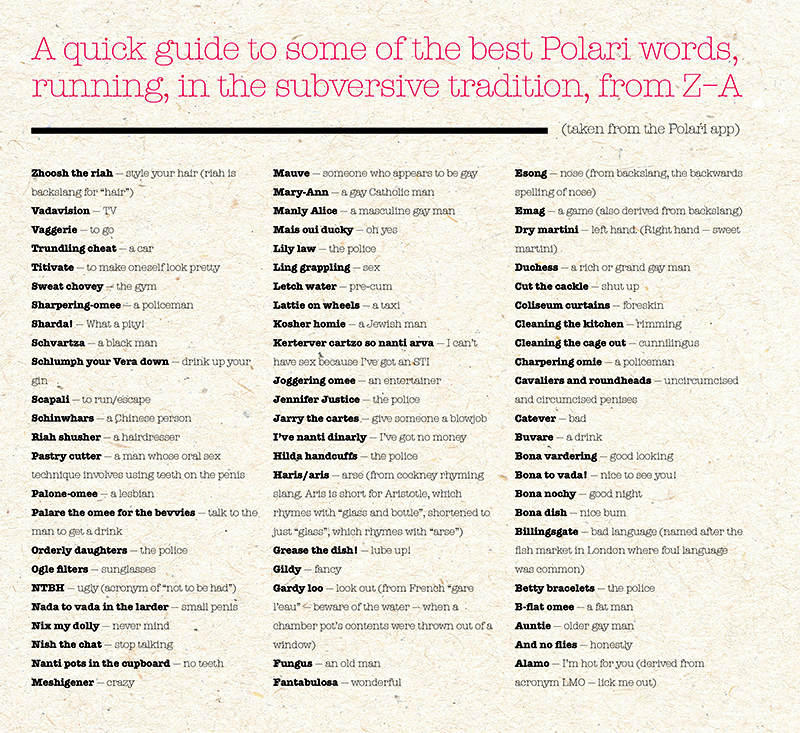
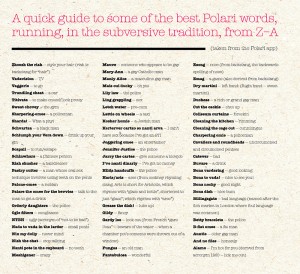
But Polari is where it all began. You’ll see from the Z–A table on the following page (done backwards in Polari’s subversive tradition) that many Polari words had common themes. It’s no accident that there were several coded names for the police — such as Sharpering Omees, Jennifer Justice, Orderly Daughters, Hilda Handcuffs, Betty Bracelets, Lily Law. The use of female names for what was, back then, a predominantly male force cheekily undermines their authority. Polari was spoken at a time when homosexuality was illegal in Britain, so avoiding detection was as important as expressing a contempt for the law and its enforcers. Polari sits in the same bracket as other cryptolects. A cryptolect is a secretive language used to confuse and exclude others and affirm the character and solidarity of a marginalised subculture. In that sense, hip hop rap, cockney rhyming slang and Polari are all cousins.
Polari’s weapon was camp — imprinting a flamboyant flair and strange panache using a complete mish-mash of words — borrowed from cockney rhyming slang, backslang (when a word is pronounced backwards such as the Polari riah, esong and emag — hair, nose and game), Yiddish, Italian, theatre slang and naval slang. Even the Aussie “cossy” (costume) features in Polari. You might have dropped a Polari word into a sentence to surreptitiously show the attractive man you were talking to that you’re gay — or test if he was. Or to avoid disapproval — even arrest. Or simply to bitch and get away with it.
Polari shows its age with some casual racism (Schvartza for black man; Schinwhars for Chinese person) but it was also a cheeky way of speaking sexily in public without attracting attention — Kerterver cartzo so nanti arva (I can’t have sex because I’ve got an STI) — was hardly something you’d broadcast. Similarly, Nada to vada in the larder (small penis) was a phrase you’d keep on the down low.
Professor Paul Baker, from Lancaster University’s Department of Linguistics, is a world expert on Polari. When asked why Polari didn’t exist in Australia (Editor’s note: Polari does indeed exist in Australia.) or why lesbians didn’t have their own Polari, he said it was because it was born out of a very oppressed group in a very particular time.
“Although Australia has ‘the beat’ as code for public restrooms, Polari flourished (in Britain) as a result of extreme oppression of gay men, plus the presence of other groups on the edges of society, all thrown together due to London’s large population,” he said.
“So the conditions for Australia weren’t the same.”
What about lesbians? Although evidence suggests they did use Polari, it was only in small numbers.
Professor John Hajek from Melbourne University’s School of Linguistics said: “Lesbians were a less identifiable group than gay men — hence they’re less known for their own subculture and therefore slang. But some terms exist, often playful. For example: Hasbian — former lesbian, Saturday night lesbian — only gay at the weekends.”
Unlike gay men, the law never specifically outlawed lesbian sex so, as with many forms of gay subculture, the women were invisible.
But is Polari an endangered language and should we preserve it? Professor Baker believes so.
“That’s why I did my PhD in it and created an app for it,” he said.
“I didn’t want the voices of the men and women who lived through that period to be forgotten. So often history is of the powerful, not the disempowered.
“But preserving something isn’t the same as reviving it. I don’t want the conditions which brought it into being to be repeated. We never need to hide our sexuality from anyone. We have nothing to be ashamed of.”
Polari was popularised by the 1960s BBC radio series Round the Horne, which featured two camp Polari speakers, Julian and Sandy. Once it gained popularity, the cat was out of the bag. 1967 saw the decriminalisation of homosexuality in Britain — hence making Polari redundant.
However, in many ways today we speak our own coded language. Take for example the zoological labels gay men apply to each other, denoting weight, age and hirsuteness. “Bear” for hairy, older and larger; “cub” for hairy, younger and larger; “otter” for hairy, younger and slimmer; “silver fox/wolf” for older and attractive; “pink panther” for a straight man who frequents gay bars to seduce women; “Woof!” to express physical approval of someone; and “twink/chicken” for younger, smoother and prettier. “Chicken” itself was a Polari word, though twink is more common nowadays.
Is this animalistic vernacular vulgar, primal and dehumanising or playfully affectionate? Or — simply another code for us to fetishise and bitch about each other?
Soto Aivalis is categorised as a cub and he said he finds it “cute and funny, even though I didn’t even know what one was 5/6 years ago”.
He said it happened more often online: “Everyone’s trying to be a bit funnier, plus it’s easier to call someone a cub in that space than face-to-face. In the real world it might come across as awkward.”
John Kuna, a member of the Harbour City Bears, agreed.
“I’ve found the majority of the bear community, since coming out, as friendly and supportive so for me the term ‘bear’ has many positive connotations. Plus, hey, I’m big and hairy so it pretty much fits,” he said.
“There’s no point trying to reject labels. People need labels to make sense of things, to identify with their ‘tribe’ so to speak. Most people want to identify with something, even those who say they don’t like being labelled will stick to certain brands or wear a certain type of clothing. Without even realising we all inadvertently try to fit in.
“To date I’ve never heard my social group use these terms as a put down. And c’mon what’s not to like about a big, stocky bear?”
However, call Craig Mack a bear (or an otter or a cub) and he’s likely to growl at you.
“I’ve always felt uncomfortable with people being judged and categorised by their looks. Labels can help you find your place in a community, but I don’t think they should wholly define your place in the world,” he said.
“They also make it difficult for us to ‘cross borders’ into other communities. More recently though, I’ve become indifferent because labels are, ultimately, meaningless.
“I’ve crossed so many communities and been the twink, the cub, the drag queen, the leather pup, the gym bunny and the party animal. I relate to all of them but none of those terms wholly define me. They all form part of who I am today, rather than a singular stereotypical characteristic.”
Outside the gay community, these animal terms are bemusing. Interestingly, today gay code is global — for example, “bear” would be understood by gay communities internationally. Due to the internet and phone apps that allow you to explore in different countries, the gay language is no longer isolated to one place and time. It has become a universally understood and adopted code within a large community. More similarly coded, quirky terms are likely to spring up and spread quickly so gay people can speak to (or about) each other in further exclusive and interesting ways.
Lesbians use similar classifications and witticisms to categorise one another. Femme, butch, bull-dyke are all common terms. Consistent lesbians tease the fluidity some women experience in their sexual orientation and use GUG (gay until graduation) for women who experiment at university, or a term popularised by Orange is the New Black — “gay for the stay” (only a lesbian while in prison).
Today’s coded gay language lacks the imagination and flair of Polari, but it does serve a similarly functional purpose. Many gay app profiles — especially in the US — will use “420 friendly” as a way of saying “I like to get stoned” without being too ostentatious (the origins of 420 are widely disputed, but the most likely etymology comes from a group of US students who used to meet at 4.20pm to smoke weed and this became adopted as code for consuming marijuana). It sits within a long tradition of using drug slang to avoid attracting the wrong attention or judgement.
To many straight people, the alphabet soup of the initialism LGBTI makes our community seem quite peculiar. However, really it shows a vibrant diversity and warm inclusiveness that endearingly, wants to see nobody feeling like an outsider. The semantics of equality may not be as sexy, catchy or witty, yet they reflect a community that has moved from marginalised and ostracised to mainstream — and even celebrated.
Now you’re speaking my language.
**This article first appeared in the October 2014 issue of the Star Observer.